Interview with Yoel Gamzou - Orchestra Sinfonica di Milano

Interview with Yoel Gamzou

Published on 09/02/2026

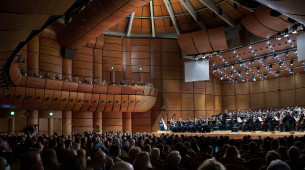
February 13 Yoel Gamzou returns to the podium at the Auditorium di Largo Mahler to present his version of Gustav Mahler’s Tenth Symphony—an Italian premiere—with the Orchestra Sinfonica di Milano. It is a work the composer left in sketch form, yet one that has always fascinated the music world. The Tenth: a farewell to the stage, or the birth of a new creative phase?

We met with Maestro Yoel Gamzou to hear about his visceral connection to Mahler’s music—and to the Tenth Symphony in particular.
Emanuele Preziati: Maestro, why did you decide to “reassemble” Gustav Mahler's Tenth Symphony?
Yoel Gamzou: It was not a conscious decision. I never thought about making it a project: it happened gradually, until it occupied my entire life. It all started in New York, when I was twelve or thirteen years old and, at the public library, I came into contact with the facsimile of the Tenth. Looking at that manuscript I immediately understood that it was a masterpiece capable of changing the history of music. I soon discovered that there were several versions, including that of Deryck Cooke, whom I studied with interest but also with skepticism. I felt the need to confront the original directly, which I began to study obsessively. Mahler had opened a door to a new aesthetic and philosophical world, an alternative to the Second Vienna School, and I wanted to understand what language he had found. After some decisive meetings, particularly with Franz Baumann, I was encouraged to continue. Since then, the Tenth has become the center of my life: I studied the manuscript day and night, until I could no longer distinguish where Mahler ended and where I began. I don't remember the exact moment I decided to complete it: I just kept going.

E.P.: So it was a personal approach to completion, not musicological like Deryck Cooke's.
Y.G.: Yes, absolutely. The project was very personal, both because of the meaning it had in my life and the way I carried it out. Cooke's version is extraordinary, and I owe him great respect: tackling such complex work first is a remarkable feat. My approach was different, more oriented towards offering the audience a complete musical experience, making some interpretative choices based on years of study. I do not claim to have found the only “corrected version”, but to have achieved a reading consistent with the spirit of the work and with the utmost conviction.
Akseli Gallen-Kallela, Portrait of Gustav Mahler,  Vienna 1907
E.P.:  Did he use only the sketches or even the more advanced parts, such as the first movement, in the completion?
Y.G.: The first movement was the most difficult, because it is not actually complete. There are several versions that contradict each other, also for historical and political reasons. The Adagio, often considered final, is the result of numerous arbitrary decisions. I had to go through some real detective work: comparing sketches, short scores, and orchestral drafts, analyzing each bar. Sometimes I spent weeks on just one measure to figure out what Mahler's intention was. The idea of being able to take that movement as it is and publish it as definitive is simply wrong.

E.P.: Can you tell us about the form of the first movement?
Y.G.: The first movement cannot be understood without the fifth. Playing the Adagio alone is a grave mistake, because it mirrors the finale, as happens in the Ninth Symphony. In the Tenth this ratio is even stronger. The great dissonant chord of the first movement, added by Mahler only at an advanced stage, returns identical in the last movement with different instrumentation. For me this is the key to the entire Symphony: when you return to the same point of the journey, the meaning has changed. After comes the epilogue, perhaps the most beautiful ten minutes Mahler ever wrote, where the acceptance of death leads to transcendence.

E.P.: In the orchestration he was inspired by other symphonies by Mahler?
Y.G.: Yes, but I tried to make a similar leap to what Mahler himself did from the Ninth to the Tenth. I expanded the use of percussion and inserted unusual instruments, reflecting what Mahler was exposed to in his New York years. Orchestration, like harmony and rhythm, also looks ahead.

E.P.:Is the Tenth the end of a journey or the beginning of something new?
Y.G.: Both. I see Das Lied von der Erde, the Ninth and Tenth as a farewell trilogy: to life, to a civilization, finally to everything. But the Tenth is also a gateway to a world we have never been able to explore. If Mahler had lived longer, he would probably have followed a different path than Schönberg.

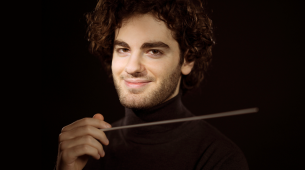
Yoel Gamzou portrayed by Bernd Schönberger
E.P.: Do you think this path could have led to composers like Shostakovich?
Y.G.: There are stylistic similarities, but spiritually they are different worlds. Mahler was always projected forward. If he had lived longer, he would have written music about the future, not the past.

E.P.:
How was his version of the Tenth received?
Y.G.: It has been performed over a hundred times, and for me it is a great honor. Every highly subjective project creates supporters and opponents. I made clear decisions, which some love and others hate, but from the first performance the response was intense and passionate.

E.P.: Does a work of art belong only to the composer?
Y.G.: It is an illusion to think so. A score is just paper until someone plays it. Every performance is already a creative act. The composer leaves a map, but the work comes to life only thanks to the performers. Composing and directing are two forms of service to art, inseparable.

E.P.: Do you think we will return to a freer interpretation of music?
Y.G.:  I don't believe in blind fidelity to the score. My models are Mahler and Furtwängler: the spirit of the work comes before the paper. The idea of absolute authenticity is unfeasible and hypocritical. We play for today's audience, not the 1820s. There is no right or wrong in art: we are all seekers, and if you seek definitive answers, you destroy art.

Emanuele Preziati

Vuoi restare aggiornato sulle nostre attività?
Iscriviti alla newsletter!

@ sinfonicami

With the contribution of

MiC Logo

Institutional Founders

Logo Lombardia Logo Comune Milano


Founders Promoters

Logo Città Metropolitana Logo Camera di Commercio Logo Banco BPM Logo Pirelli Intesa Sanpaolo Logo

With the support of

Fondazione Cariplo Logo

Partner

A2A Forestami

Technical sponsors

Bigi Cravatte Milano Landor

Media Partner

Rai Cultura Radio 3 Corriere della Sera Logo Classic Voice

Digital Partner

Music Paper
How to contact us
Ticket office: Largo Gustav Mahler, Milan
La biglietteria è aperta da martedì a domenica, dalle 12.00 alle 19.00
T. 02 83389.401
[email protected]
Auditorium of Milan
Largo Mahler
Milan
M.A.C.
Piazza Tito Lucrezio Caro 1
Milan
© Fondazione Orchestra Sinfonica e Coro Sinfonico di Milano Giuseppe Verdi
Piazza Tito Lucrezio Caro, 1 - Milan
Tax Code 97119590152 - VAT number 11024950153