Andrzej Ojczenasz, Damian Dziweńka and Francesco Darmanin have been awarded the three composition commissions of Europasinfonie, the project led by Dresdner Sinfoniker together with its European partners.
Andrzej Ojczenasz, Damian Dziweńka and Francesco Darmanin are the three composers selected to receive the composition commissions of Europasinfonie, the project led by Dresdner Sinfoniker together with eleven European orchestral and choral partners, including the Orchestra Sinfonica di Milano.
From more than 220 applications submitted from 26 countries, an international jury selected the three composers who, over the coming months, will develop new works to be given their world premieres in June 2027 as part of the European project.
The three winners were presented on 30 September during a press conference at MESSE DRESDEN, joining remotely from their respective countries to share their musical ideas and expectations for a highly unusual compositional challenge: writing for an orchestra that will not be gathered in a single venue, but distributed across several European countries.
A RESPONSE FROM ACROSS EUROPE
The international composition competition attracted a particularly broad response, with applications from 26 countries, including France, Spain, Italy, Germany, Ukraine, Slovenia, Lithuania, Slovakia, Iceland and Cyprus.
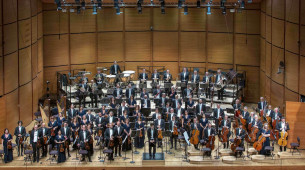
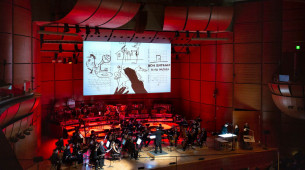
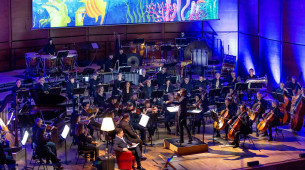
Composers were asked to imagine new works capable of engaging with the unique conditions of Europasinfonie. In June 2027, ten orchestras and two choirs from twelve European countries will be connected through GÉANT, Europe’s research and education network, and will perform together in real time.
Extremely low latency will be made possible, among other technologies, by systems developed by the Czech research organisation CESNET in collaboration with DISK Systems. In some cases, the musicians involved will be separated by distances of more than 3,500 kilometres.
COMPOSING FOR A NEW MUSICAL INSTRUMENT
The commissions present the three composers with an unprecedented challenge. Their works will not be written for a traditional orchestra gathered in the same space, but for a musical ensemble whose members will be distributed across different locations in Europe.
The technical conditions of real-time transmission — and above all the minimal delay between the various locations — will therefore become part of the musical conception of the new compositions themselves.
Two composers will each receive a commission for a work lasting between 15 and 20 minutes for large symphony orchestra, while the third will be commissioned to write a work for orchestra and choir.
Europasinfonie also aims to support a new generation of composers: according to the competition rules, at least one of the selected composers had to be aged 35 or under. All three winners fall within this age group: Andrzej Ojczenasz is 34, Damian Dziweńka 32 and Francesco Darmanin 30.